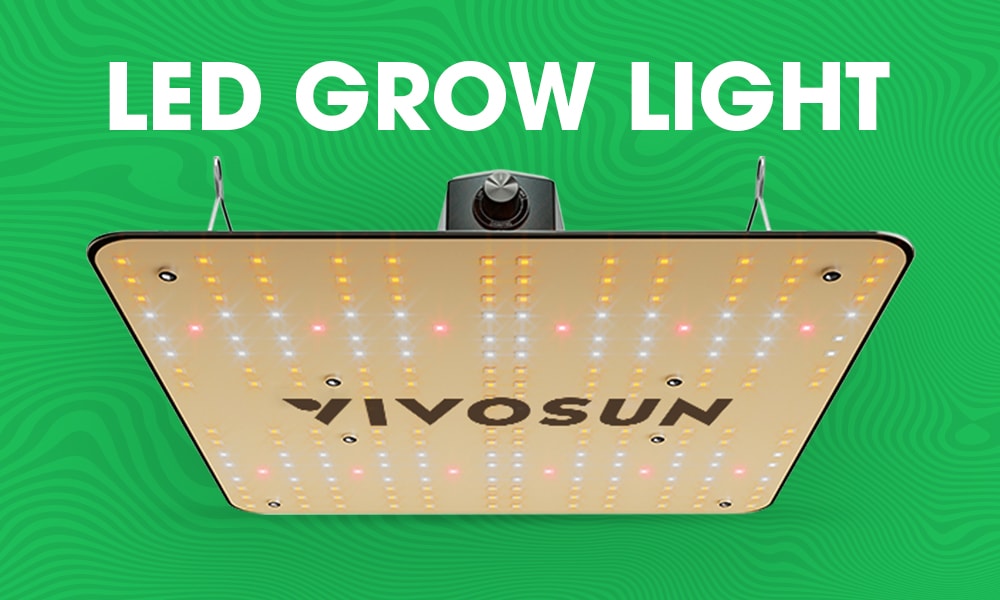
LED grow lights are one of the most efficient options for indoor growing, but choosing the right fixture involves more than comparing wattage. PPFD, efficacy, spectrum, coverage, and grow space all affect performance. This guide explains how to choose an LED grow light and compares VIVOSUN's AeroLight, Lumelight, Lumeray, and LED Linear options.
If you want the full breakdown of how LEDs compare to HPS, MH, and CMH lighting, check out our Grow Light Buying Guide — that article covers the differences between light types in depth.
What Makes an LED Grow Light Different?
A grow light emits energy as both heat and visible light optimized for photosynthesis. You hang it above your canopy so it "pours" light down onto the leaves, stems, and flowers, just like the sun would outdoors.
There are three main categories of grow lights on the market: High-Intensity Discharge (HID) — Metal Halide (MH), Ceramic Metal Halide (CMH), and High-Pressure Sodium (HPS); T5 Fluorescent; and Light Emitting Diodes (LED).
LEDs stand apart from the other two because they don't rely on external ballasts, bulbs, or reflectors. They run up to 80% cooler than HID bulbs while producing as much (or more) usable light, they need very little extra equipment, and they last far longer — typically around 50,000 hours, or roughly 2,080 days of continuous use — without dimming over time.
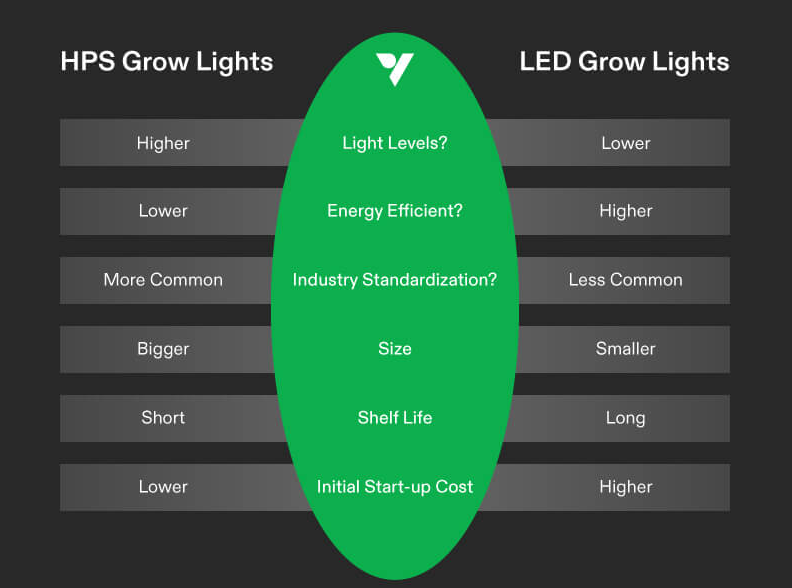
Pros and Cons at a Glance
| Pros of LED Grow Lights | Cons of LED Grow Lights |
|---|---|
| More energy-efficient than HID and T5 — roughly half the electricity draw of T5 fluorescent for comparable output | Higher upfront cost than HID or T5 |
| Higher light intensity than T5 and most HID systems; can be used through the entire grow cycle without swapping bulbs | Adjusting spectrum on some models requires a separate controller |
| Runs up to 80% cooler than HID, so lights can be hung closer to the canopy for faster growth | Standardization varies widely between brands — quality between manufacturers can differ a lot |
| Lifespan of ~50,000 hours with gradual light-output depreciation over time | Very low-heat units may need supplemental heating in cold grow spaces |
| No reflectors, ballasts, or dedicated fixtures required | Cheap LEDs can cut corners on diode quality and driver components |
What to Check Before You Buy: Key LED Specs
Before comparing individual lights, it helps to understand what the key specifications mean. This guide focuses on the factors that matter most when choosing an LED grow light, including wattage, efficacy, PPFD, coverage, spectrum, and warranty.
Wattage & Efficacy — Wattage tells you how much electrical power a grow light draws from the wall, but it doesn't tell you by itself how much usable light reaches your plants. When comparing LED grow lights, look at both power consumption and efficacy, measured in micromoles per Joule (µmol/J). Higher efficacy means the fixture produces more photosynthetic light for each watt of electricity it uses. Your ideal wattage also depends on your grow space, coverage, and growing conditions, so don't choose a light based on wattage alone.
For help determining how much lighting your space needs, see our guide to how many grow lights you need.
PPFD & Coverage — Photosynthetic Photon Flux Density (PPFD) measures the amount of usable light reaching your plant canopy, expressed in µmol/m²/s. When comparing LED grow lights, don't rely on wattage alone — check the fixture's PPFD and PAR map to see how much light it delivers and how evenly that light is distributed across your growing area. A well-designed light should provide consistent coverage with minimal drop-off at the edges.
For a deeper explanation of PPFD, light intensity, and how to position your grow light, see our guide to how far seedlings should be from a grow light.
Light Spectrum — Spectrum determines the wavelengths of light an LED grow light provides to your plants. Most modern LED grow lights use a full-spectrum design that combines multiple wavelengths to support plants throughout the growing cycle. When comparing lights, look for a balanced spectrum that can support both vegetative growth and flowering, rather than choosing a fixture based on color alone.
For a deeper look at how full-spectrum lighting works and what to consider when choosing one, see our guide to full-spectrum LED grow lights.
Warranty — Because LEDs are built to last tens of thousands of hours, the warranty should reflect that. VIVOSUN backs its LED grow light systems with warranties ranging from 3 to 5 years depending on the model.
LED Grow Light Form Factors
LED grow lights come in a few distinct physical formats. Understanding the difference will help you make sense of why VIVOSUN offers "quantum" and "bar" style options within the same product line (more on that below).
Quantum Boards
The quantum board design uses a flat, compact panel covered with evenly distributed LED diodes. This low-profile layout provides broad, consistent coverage across the canopy while keeping the fixture relatively simple to install and maintain. VIVOSUN uses this design across models in both its Lumelight and AeroLight lines, making it a practical choice for growers who want straightforward, even top-down lighting.
Choose a quantum board design if: you want simple installation, broad canopy coverage, and a compact fixture for a standard grow setup.
Next-Gen Design
VIVOSUN's Next-Gen design uses a multi-bar layout that distributes LEDs across a wider footprint instead of concentrating them on a single flat board. The open structure can help create more even light distribution across the canopy while allowing greater airflow around the fixture. VIVOSUN offers this design in the Lumelight and AeroLight lines for growers looking for a wider, more flexible lighting layout.
Choose a Next-Gen design if: you want broad light distribution and an open fixture layout, particularly for a wider or more densely trained canopy.
Panel-Style Design
The panel-style design is commonly used in VIVOSUN's Lumeray series for supplemental lighting. Its compact panel format makes it easy to position along the sides or lower areas of a grow space, helping add light to parts of the canopy that may receive less direct light from an overhead fixture.
Choose a panel-style Lumeray light if: you already have a primary top light and want to supplement light around the sides or lower canopy.
The VIVOSUN LED Grow Light Lineup: Which One Should You Buy?
This is the part most buying guides skip — and it's usually the actual question you came here to answer. VIVOSUN's current LED grow light lineup is built around four product families, each solving a different job in your grow space:
| Product Line | Position | Best For |
|---|---|---|
| AeroLight | Top light — built-in circulation fan, tunable spectrum, works with GrowHub Pro smart control | Growers who want maximum control, airflow, and yield in one fixture |
| Lumelight | Top light — entry-level full spectrum, smart control compatible | New growers who want smart features without AeroLight's price tag |
| Lumeray | Side light / under-canopy light | Supplementing an existing top light to fill in shadowed lower bud sites |
| LED Linear | T5 grow light | Seedlings, clones, and early propagation |
AeroLight — The Flagship Top Light
AeroLight is VIVOSUN's top-tier main light, built for growers who want more than "just a light." Every AeroLight fixture integrates a built-in circulation fan, so you get airflow and light from a single unit instead of hanging a separate clip fan. Spectrum is tunable across seedling, vegetative, and flowering settings, and the line pairs with GrowHub Pro for scheduling, sunrise/sunset simulation, and remote monitoring from the VIVOSUN app.
AeroLight is available in two form factors:
- AeroLight (Quantum board style) — flat, even canopy coverage; the simplest option to hang and maintain
- AeroLight (Next-Gen/bar-style design) — bar-style light spread with better mid-canopy penetration and airflow between bars, suited to denser plant training (SCROG/SOG setups)
Choose AeroLight if: you're running a serious grow, want integrated air circulation without extra hardware, and plan to use smart, automated environmental control.
Lumelight — Full Spectrum, Smart, Entry-Level
Lumelight covers the same "top light" role as AeroLight, but without the built-in fan or the higher-end spectral tuning — it's positioned as the accessible entry point into full-spectrum, smart-compatible LED lighting. It still connects into the VIVOSUN smart ecosystem for basic scheduling and control, just without AeroLight's advanced features.
Like AeroLight, Lumelight comes in both quantum board and bar-style, so you can pick the light-distribution pattern that fits your tent and training style even at the entry-level price point.
Choose Lumelight if: it's your first grow, you want full-spectrum LED performance and smart control basics, and you don't need integrated circulation or advanced spectral tuning.
Lumeray — Side and Under-Canopy Lighting
No top light — regardless of wattage — can fully light the lower third of a dense, well-trained canopy. That's where Lumeray comes in. Designed as a side light and under-light, Lumeray clips or mounts along your tent walls or lower canopy to push light horizontally into the areas your top light can't reach, helping provide additional light to lower branches and areas that receive less direct illumination from the main fixture.
For a full breakdown of side lighting placement and technique, see our dedicated guide: The Best Side Lighting.
Choose Lumeray if: you already run an AeroLight or Lumelight as your main light and want to close the gap on lower-canopy light penetration, especially in SCROG, SOG, or heavily trained setups.
LED Linear — T5 Lighting for Seedlings and Clones
Seedlings and clones don't need — and can be damaged by — the intensity of a full-power top light. VIVOSUN's LED Linear T5 fixtures deliver the gentler, evenly-diffused light young plants need during germination and early vegetative growth, at a much lower operating cost than running a full-size light over a propagation tray.
Choose LED Linear if: you're germinating seeds, rooting clones, or running a dedicated propagation/veg tent separate from your flowering space.
Quick Decision Guide
| If you're… | Consider… |
|---|---|
| A first-time grower on a budget | Lumelight (quantum board) |
| Running a dense, trained canopy and want max control | AeroLight (bar style) |
| Running a standard, single-tent grow and want simplicity | AeroLight (quantum board) |
| Already have a top light but seeing weak lower buds | Add Lumeray |
| Starting seeds or rooting clones | LED Linear |
How to Set Up Your LED Grow Light
Setting up an LED grow light is simple, and every VIVOSUN fixture ships with rope ratchet hangers to make it easier.
Step 1: Gather your supplies — light, hangers, and rope ratchets.
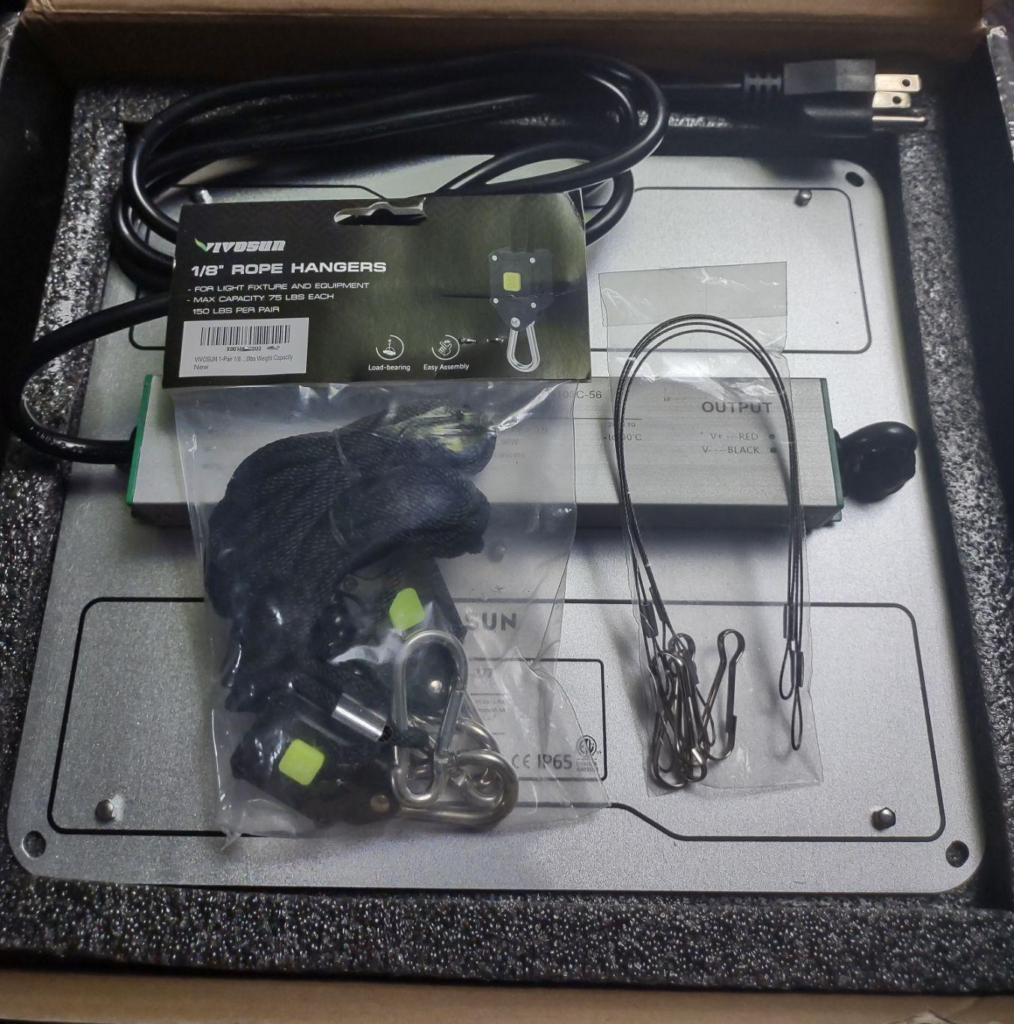
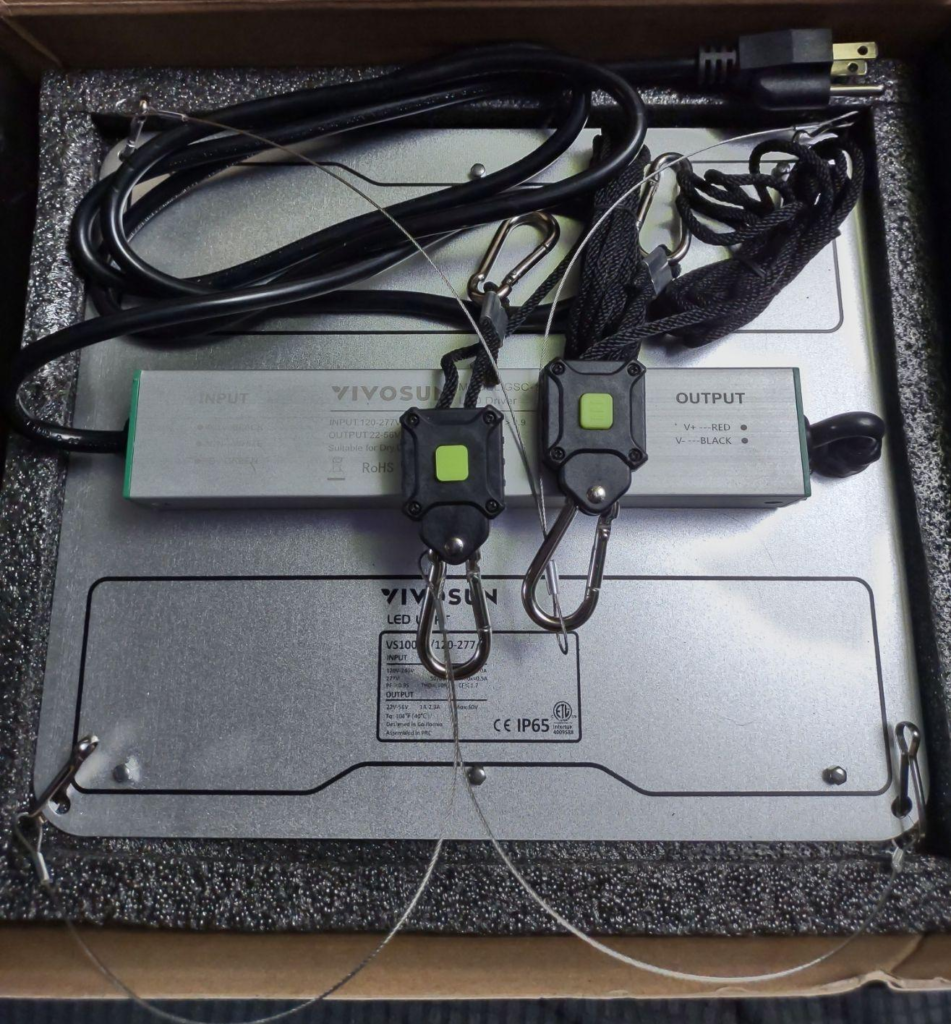
Step 2: Hook the metal hangers to your light, then connect the carabiners on the rope ratchet hangers to the hoops on the metal hangers.
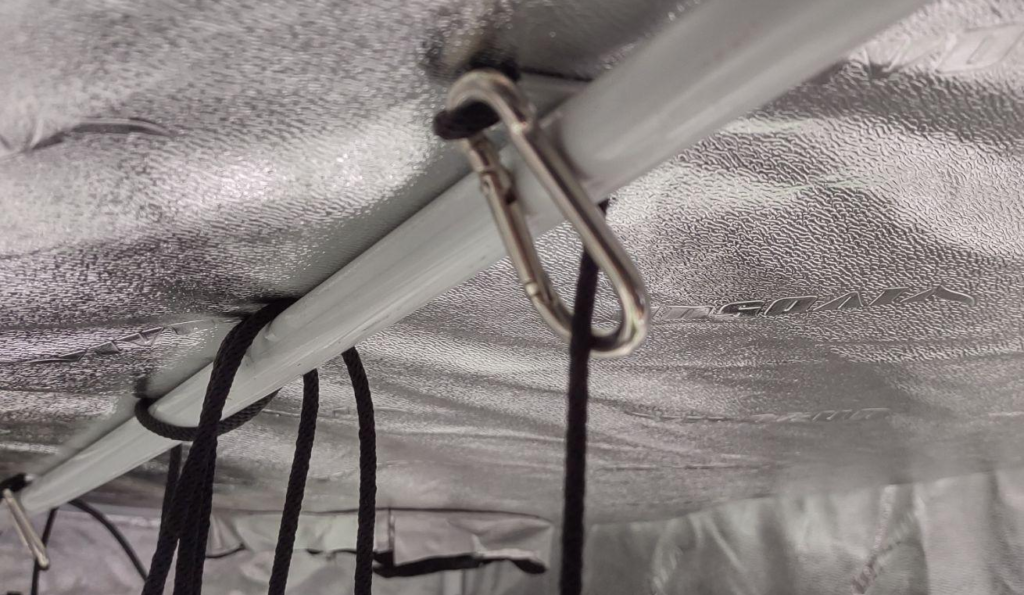
Step 3: Hang the long end of the rope hanger over your tent's crossbars and connect it to the rope.
Step 4: Pull the free end of the rope through the ratchets to raise the light to the correct height for your plant's current growth stage.
For exact hanging distances by wattage and growth stage, see How Far Away Should My Grow Lights Be?
Frequently Asked Questions
Do I need AeroLight, or is Lumelight enough? If you want integrated circulation, advanced spectral tuning, and full GrowHub Pro automation, AeroLight is worth the upgrade. If you're growing your first tent and mainly want reliable full-spectrum LED coverage with basic smart features, Lumelight covers the essentials at a lower cost.
Do I need Lumeray if I already have a top light? Only if you're seeing weak growth or airy buds low on the plant. A single top light — no matter how powerful — loses intensity as it travels down through a dense canopy. Lumeray is a supplement, not a replacement, for your main AeroLight or Lumelight fixture.
What's the difference between the quantum board and Next-Gen versions of AeroLight/Lumelight? Quantum board versions use a single flat panel for simple, even coverage — a good default for most tents. Next-Gen (bar-style) versions spread individual light bars across a wider footprint, improving penetration into a trained, multi-cola canopy and increasing airflow between the diodes. If you train your plants heavily (SCROG/SOG), the bar-style is usually the better fit.
Can I use LED Linear as my only light for a full grow cycle? No — LED Linear T5 fixtures are built for the lower light intensity seedlings and clones need. Once plants move into vegetative growth, they'll need a full-power light like AeroLight or Lumelight to keep developing properly.
How long do VIVOSUN LED grow lights last? LED diodes are rated for roughly 50,000 hours of use — about 2,080 days of continuous operation — and VIVOSUN backs its LED grow light systems with 3 to 5-year warranties depending on the model.
If you have any questions, reach out to us on Reddit Community or Facebook — we're always happy to help you find the right light for your grow.
Explore the full lineup: AeroLight · Lumelight · Lumeray · LED Linear T5