Why Does Light Distance Matter?
The distance between your light and the plant canopy controls three things at once — and it's one of the most common places indoor growers leave yield on the table.
Light intensity (PPFD). For a point source, light intensity follows the inverse-square law. In real grow-light setups, especially with large LED fixtures, PPFD changes with distance in a more complex way because fixture size, optics, and beam angle also affect distribution.
Coverage and uniformity. Higher lights spread light more evenly across the whole canopy but reduce intensity. Lower lights concentrate more PPFD on a smaller central area, which can create "hot spots" in the middle and dark edges.
Heat. HPS, MH and CMH bulbs run hot — too close causes heat stress, leaf bleaching and tip burn. Even cool-running LEDs can cause "light burn" from raw intensity alone if hung too close.
Get the height wrong and you'll see one of two classic problems:
- Too far → tall, spindly, stretched plants with weak stems and airy buds.
- Too close → bleached, curled, stunted plants that can't photosynthesize.
The goal is a "sweet spot": high PPFD, even coverage, and no stress.
How Far Should Grow Lights Be From Plants?
Your plants' light needs change dramatically as they develop — what's perfect for a flowering plant will devastate a seedling. Use this chart as your starting point, then adjust to your specific setup.
These are general starting ranges, not universal requirements. Higher PPFD can be appropriate for high-light crops and optimized environments, while lower levels may be better for seedlings, low-light plants, or setups without supplemental CO₂.
| Growth stage | LED distance | PPFD target | Light schedule |
|---|---|---|---|
| Seedling / clone | 12–24 in (30–60 cm) | 100–300 μmol/m²/s | 16–18 hrs on |
| Vegetative | 18–24 in (45–60 cm) | 300–600 μmol/m²/s | 18 hrs on |
| Early flower | 12–18 in (30–45 cm) | 500–700 μmol/m²/s | 12 hrs on |
| Late flower | 12–18 in (30–45 cm) | 700–1000 μmol/m²/s | 12 hrs on |
For photoperiod cannabis, 18/6 during vegetative growth and 12/12 during flowering are common schedules.
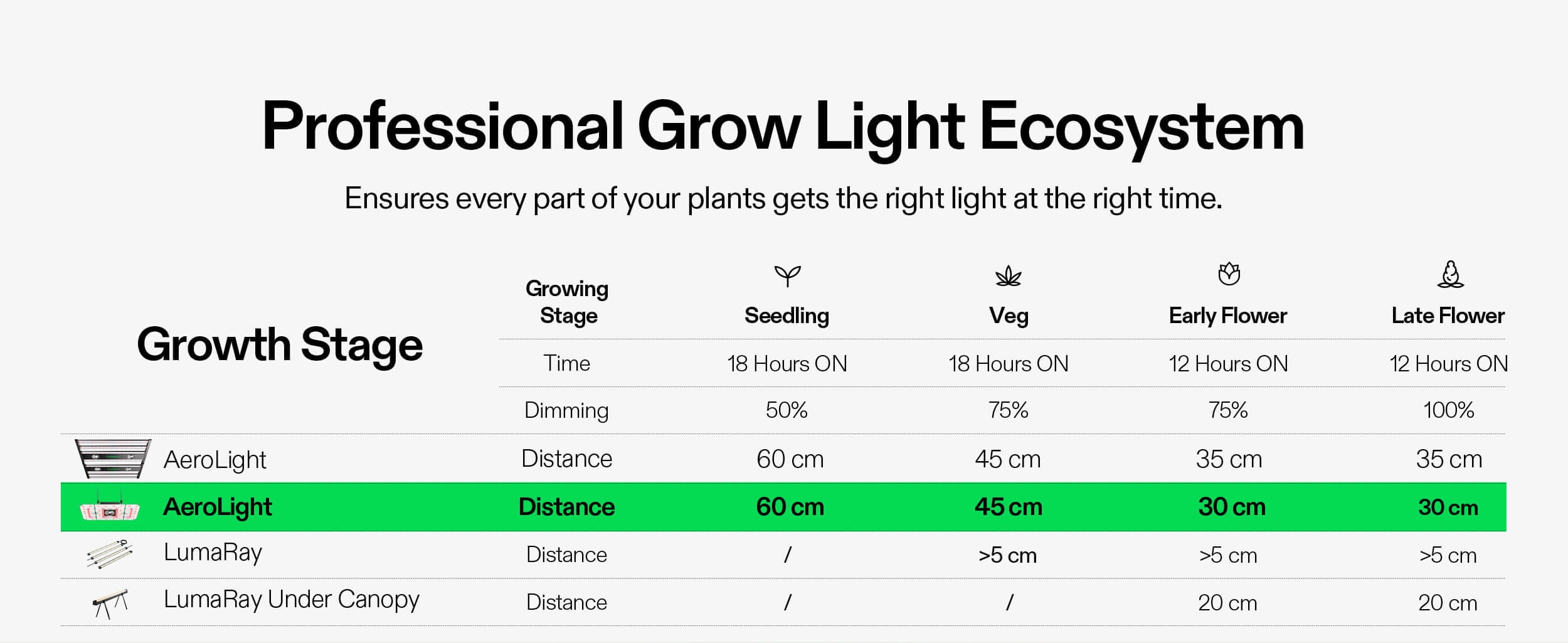
Distances are for full-spectrum LED panels at full power. If your light has a dimmer, you can hang slightly closer and reduce power — see the VIVOSUN chart below. Seedling distance varies most by fixture type: T5 and linear fixtures can sit much closer (4–12 in), while HID stays 24–36 in. For the fixture-by-fixture breakdown, see how far grow lights should be from seedlings.
Grow Light Distance by Light Type
Distance is only a starting point. PPFD at the canopy is a better way to determine whether plants are receiving the right amount of light.
LED Grow Lights
Wattage can provide a rough starting point, but it should not be used as the primary way to set hanging height. Different fixtures with the same wattage can produce very different PPFD levels.
Start with the manufacturer's recommended hanging height, then use PPFD and plant response to fine-tune the distance.
| LED wattage | Distance from canopy |
|---|---|
| 100–300W | 12–24 in (35–60 cm) |
| 300–600W | 18–36 in (45–90 cm) |
| 600W and up | 24–36 in (60–90 cm) |
Our baseline: keep LEDs at least 12 inches above the canopy. Even though LEDs don't throw heat like HPS or CMH bulbs, high-intensity LEDs can still "sunburn" your leaves and, over time, reduce productivity.
HPS & Metal Halide (HID)
HID bulbs run hot, so they need more clearance. Our commercial grower partners typically start with HPS lamps 20–26 inches above the canopy and adjust from there.
Rough LED Hanging-Height Starting Points by Power
| Wattage | Distance from canopy |
|---|---|
| 150W | 8–12 in (20–30 cm) |
| 250W | 10–14 in (25–35 cm) |
| 400W | 12–19 in (30–48 cm) |
| 600W | 14–25 in (35–64 cm) |
| 1000W | 16–31 in (41–79 cm) |
CMH / LEC Grow Lights
Ceramic metal halide runs hotter than HPS and is more prone to burning plants. Keep a 315W CMH/LEC 18–24 inches above the canopy, and a 630W model 24–30 inches — this reduces leaf stress.
Fluorescent Grow Lights (T5 / CFL)
Fluorescent bulbs are weak in both PAR and heat output. Our T5s are mainly designed for low-light plants, but with the right planning they produce excellent results. Keep fluorescents as close as possible — 6–12 inches — as long as they pass the hand test. They rarely get hot enough to burn.
Distance vs. PPFD: Which Matters More?
Understanding these three terms turns guesswork into a dialed-in grow.
PAR (Photosynthetically Active Radiation) is the specific wavelengths of light — 400–700 nanometers — that plants actually use for photosynthesis. It spans the blues, greens, yellows, oranges and reds that plants absorb and convert into energy.
PPFD (Photosynthetic Photon Flux Density) measures how many PAR photons hit a given area each second, in μmol/m²/s (micromoles per square meter per second). It's the number that tells you how much usable light is reaching your canopy at a given height.
DLI (Daily Light Integral) is the total amount of usable light a plant receives over a full day — essentially PPFD × hours. A lower PPFD run for more hours can equal a higher PPFD run for fewer hours.
Optimal PPFD targets by stage:
| Growth stage | PPFD target |
|---|---|
| Seedling / clone | 100–300 μmol/m²/s |
| Vegetative | 300–600 μmol/m²/s |
| Early flower | 500–700 μmol/m²/s |
| Late flower | 700–1000 μmol/m²/s |
These PPFD ranges are general starting points for high-light indoor crops and should not be treated as universal targets for every plant species.
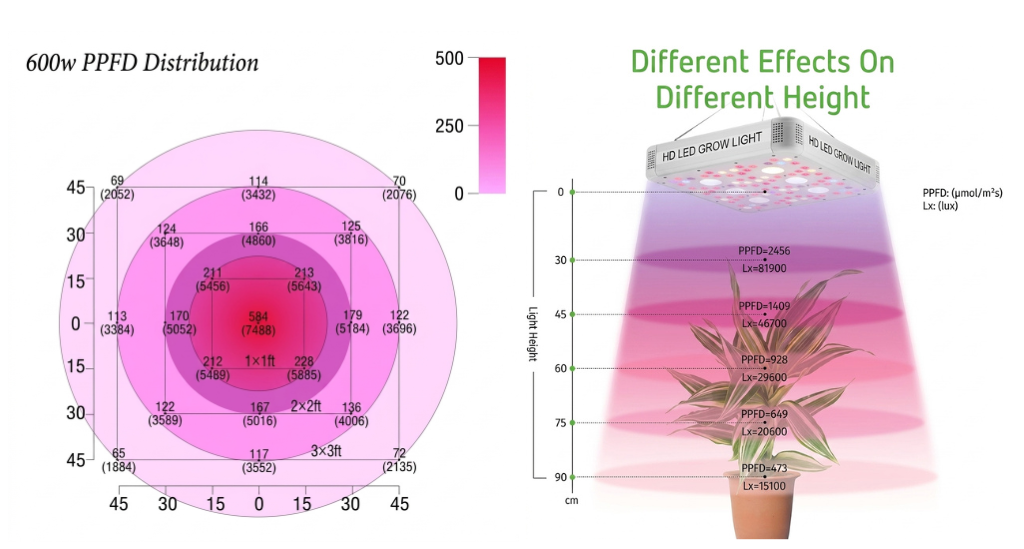
In a perfect world you'd coat every leaf with 100% of your lamp's output — that isn't possible, but a PAR map (measuring PPFD at different heights and positions) gets you close. In general, lowering a fixture increases PPFD at the canopy but can reduce the illuminated footprint and increase the risk of uneven coverage.
How to Tell if Your Grow Light Is Too Close (Light Burn)
Even with correct initial placement, monitor daily. Too-close lights show these warning signs:
- Bleached or white leaf tips — the most common symptom, on the leaves nearest the light.
- Yellow or brown spots — tissue damage from excessive intensity.
- Upward-curling ("tacoing") leaves — the plant reducing its exposed surface.
- Slow or stunted growth — energy diverted to stress response.
Light burn vs. nutrient burn: light damage appears on the upper leaves first and looks bleached/whitish; nutrient issues usually show on lower leaves with brown, crispy edges. If symptoms are concentrated on the tops closest to the light, it's the light — even if it looks like a deficiency.
How to Tell if Your Grow Light Is Too Far Away
Lights positioned too high cause the opposite problem:
- Stretching / "leggy" growth — long internodes and thin, weak stems reaching for light.
- Pale green or yellow leaves — not enough light for chlorophyll production.
- Slow growth — not enough energy for robust development.
- Small, airy flowers — inadequate light during bloom.
How to Adjust Grow Light Height
Dialing in the perfect height:
- Start high and work down. Begin at the maximum recommended distance for the stage. It's easier to recover from insufficient light than from light burn.
- Lower gradually. Drop the light 1–2 inches every 2–3 days, watching for stress after each change.
- Use the dimmer. If your LED has dimming, start seedlings at 25–50% and increase power as the plant matures — often easier than constantly re-hanging.
- Verify with a meter. Lux can be used as a rough relative indicator for white LED fixtures, but it cannot reliably be converted to PPFD with a single universal factor. For accurate measurements, use a quantum/PAR meter.
The 30-second hand test: For heat-producing fixtures such as HPS or MH, a hand test can provide a rough indication of excessive radiant heat, but it cannot measure light intensity. For LEDs, use manufacturer PPFD maps or a quantum/PAR meter whenever possible.
Frequently Asked Questions
How far should grow lights be during flowering? During flowering, many high-light crops can benefit from higher PPFD, but the appropriate level depends on the species, cultivar, environment, and CO₂ availability. For photoperiod-sensitive plants, the light/dark cycle—not simply higher PPFD—controls the flowering response.
What happens if grow lights are too close to plants? Plants develop light burn: bleached white or yellow leaf tips, brown spots, upward-curling leaves and stunted growth. Severe cases cause permanent tissue damage. Always watch the upper leaves — they show the earliest warning signs.
How do I know if my plants need more light? Plants needing more light show stretching (tall, weak stems), pale or yellowing leaves, slow growth, and small or loose flowers. If plants are leaning toward the light source, they're signaling insufficient intensity.
Can I leave grow lights on 24 hours a day? No. Most plants benefit from a daily dark period, and continuous 24-hour lighting is generally unnecessary. Photoperiod plants require an appropriate light/dark cycle, while some crops may tolerate longer photoperiods.
Do I need a PAR meter to set grow light distance? A PAR/quantum meter is the most reliable way to measure PPFD at canopy level. If you don't have one, start with the manufacturer's recommended height and monitor plant response. Smartphone lux-meter apps can be useful for comparing relative changes, but they should not be treated as a precise PPFD measurement.
How far should HPS grow lights be from plants? HPS bulbs run hot and need 16–31 inches depending on wattage — roughly 14–25 inches for a 600W bulb, and 16–31 inches for 1000W. Always finish with the 30-second hand test.
How far should grow lights be from autoflowers? Keep lights at the same stage-based distances (12–24 in for seedlings, 18–24 in veg, 12–18 in flower) but use lower intensity. Autoflowers can be grown under longer photoperiods such as 18/6 or 20/4. Because longer photoperiods increase daily light exposure, growers should consider DLI rather than reducing PPFD automatically.
Key Takeaways
- Start high, adjust low — begin at the maximum distance and lower gradually over days, not hours.
- Stage drives distance — seedlings 12–24 in (4–12 in for T5/linear), veg 18–24 in, flower 12–18 in.
- Match distance to light type — LEDs 12–24 in, HPS 16–31 in, CMH 18–24 in, fluorescent 6–12 in.
- Watch your plants — they communicate through leaf color, texture and growth pattern.
- Use dimming + a PAR meter — intensity control beats constant re-hanging.
Getting grow light distance right is one of the highest-leverage moves in indoor growing. The difference between average and exceptional yields often comes down to lighting.