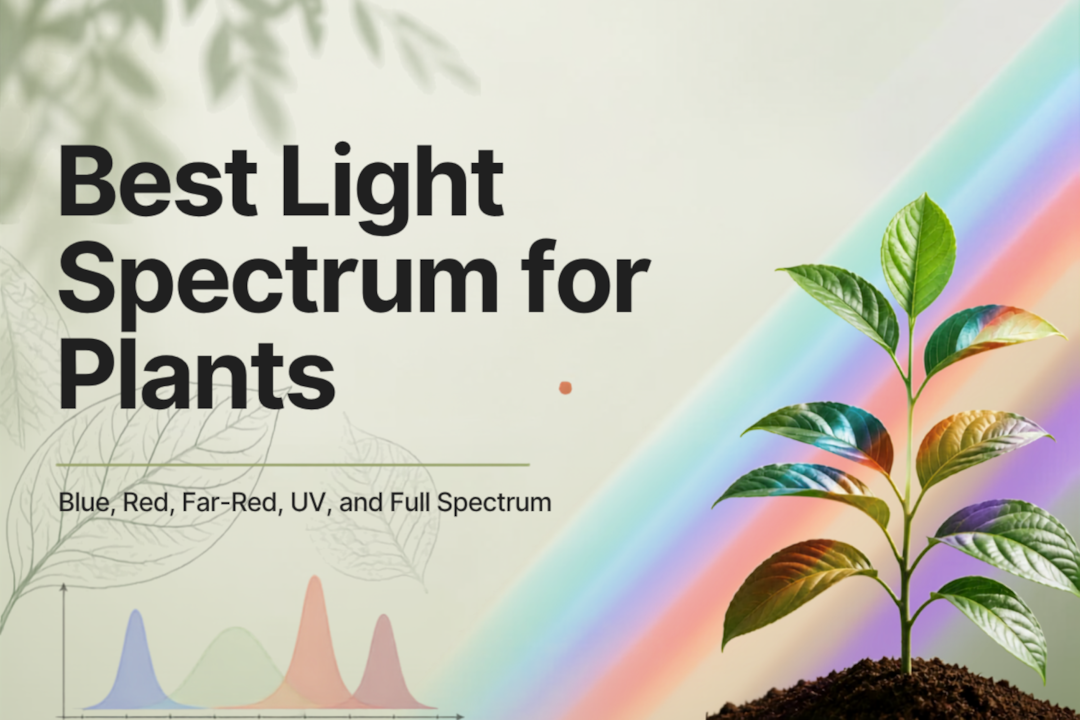
If you've ever compared two grow lights with the same wattage but gotten wildly different results, spectrum is usually the reason.
Understanding plant light spectrum matters because plants don't just need "more light" — they need the right light at the right growth stage. A seedling flooded with intense red-heavy light will stretch and get leggy. A flowering plant starved of red and far-red will produce smaller, less dense buds. This is where the debate between full-spectrum grow lights and tunable-spectrum grow lights comes in: one gives you a fixed, balanced spectrum for the whole grow, while the other lets you shift the spectrum ratio as your plant moves from seedling to veg to flower.
This guide breaks down what each part of the light spectrum actually does, how PAR, PPF, PPFD, and DLI relate to spectrum and intensity, and how to match spectrum to each growth stage. We'll also look at how tunable systems like the VIVOSUN GrowHub Controller and VIVOSUN App make spectrum adjustment simple, even for growers who don't want to think about wavelengths at all.
What Is Light Spectrum?
Light spectrum refers to the range of wavelengths a grow light emits, measured in nanometers (nm). Sunlight contains a full range of wavelengths, from ultraviolet through visible light to infrared. Indoor grow lights are engineered to emphasize the wavelengths plants actually use for photosynthesis and growth signaling, which is why "spectrum" is one of the first specs serious growers check before wattage or price.
Blue Light
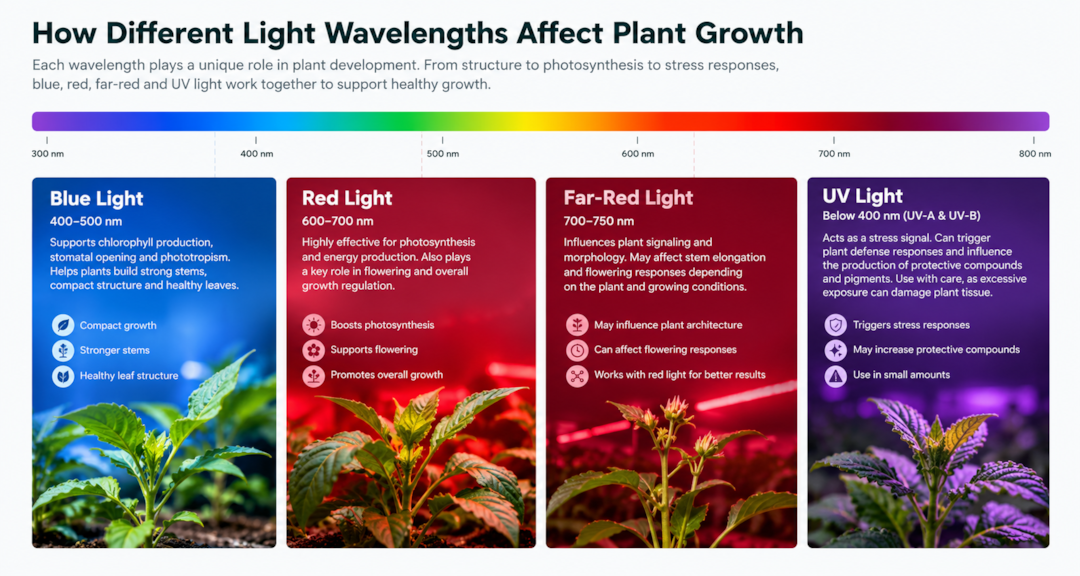
Blue light falls roughly between 400–500 nm. Plants use it to regulate stomatal opening, chlorophyll production, and phototropism (growth toward the light source). A blue-heavy spectrum keeps plants compact, encourages thicker stems, and produces denser leaf structure — which is exactly why blue is emphasized during the seedling and vegetative stages, when strong structural growth matters more than stretching upward.
Red Light
Red light (around 600–700 nm) is the primary driver of photosynthesis. It's absorbed efficiently by chlorophyll and directly fuels the chemical reactions that convert light into plant energy. Red light also plays a major role in triggering and sustaining flowering, which is why flowering-stage spectrums shift heavily toward the red end.
Far-Red Light
Far-red light (roughly 700–750 nm) sits just outside the range most people consider "visible." It interacts with red light through the plant's phytochrome system and can influence photosynthetic responses and plant morphology. Its effects depend on the overall spectrum and growing conditions. Far-red light can influence plant architecture, including stem elongation, and may affect flowering responses depending on the plant and growing conditions.
UV Light
Ultraviolet light (UV-A and UV-B, below 400 nm) isn't essential for photosynthesis, but it acts more like a stress signal. Controlled UV exposure can trigger plant stress responses and influence the production of protective compounds and pigments. However, excessive UV exposure can damage plant tissue, so UV should be used carefully and according to the plant species and light source. Because UV can cause damage at high doses, it's typically introduced in small amounts and mainly during the later stages of growth.
What Is PAR and How Does Light Intensity Affect Plant Growth?
PAR (Photosynthetically Active Radiation) refers to the band of light, roughly 400–700 nm, that plants can actually use for photosynthesis. It covers blue, green, and red wavelengths — basically the visible spectrum minus far-red and UV. Spectrum describes the wavelengths a light source emits, while PPF, PPFD, and DLI describe the quantity of photosynthetically active photons produced, delivered, or accumulated.
Three metrics matter most when evaluating light intensity:
| Metric | What It Measures | Why It Matters |
|---|---|---|
| PPF (Photosynthetic Photon Flux) | Total amount of PAR light produced by a fixture per second, measured in micromoles per second (μmol/s) | Tells you the raw light output of the fixture itself |
| PPFD (Photosynthetic Photon Flux Density) | Amount of PAR light landing on a specific area, measured in μmol/m²/s | Tells you how much usable light your plants are actually receiving at canopy level |
| DLI (Daily Light Integral) | Total PAR light accumulated over a full day, measured in mol/m²/day | Tells you the cumulative light "dose" a plant gets per day, factoring in both PPFD and photoperiod |
In short: PPF is what the light produces, PPFD is what your canopy receives, and DLI is what your plant accumulates over 24 hours. Matching spectrum to growth stage only works if intensity is also dialed in correctly — even the ideal spectrum won't perform well if PPFD is too low or too high for that stage.
Choosing the Right Spectrum for Each Growth Stage
Plants don't need the same spectrum from seed to harvest. As a plant moves through seedling, vegetative, and flowering stages, its light needs shift from structural (blue-dominant) to reproductive (red and far-red-dominant).
Seedling Stage
Young seedlings have shallow root systems and limited energy reserves, so the goal is steady, gentle growth rather than rapid stretching. A blue-rich spectrum at lower intensity keeps seedlings compact and helps them develop strong stems and healthy leaf structure before they're pushed into rapid vegetative growth.
Vegetative Stage
During veg, plants need to build out leaf canopy, branching structure, and root mass. A spectrum that leans blue with moderate red keeps growth dense and bushy rather than tall and thin, while intensity is gradually increased to support faster photosynthesis and biomass accumulation.
Flowering Stage
Once a plant transitions to flowering, red light becomes the dominant driver, supported by far-red to enhance photosynthetic efficiency and encourage bud development. UV can be introduced in small doses during this stage to support pigment and trichome production. Intensity (PPFD/DLI) is typically increased further, since flowering plants can utilize much higher light levels than seedlings or early veg growth.
Quick Reference: Spectrum by Growth Stage
| Growth Stage | Spectral Focus | Main Goal | Practical Approach |
|---|---|---|---|
| Seedling | Blue-rich, balanced spectrum | Compact growth | Use a gentle, balanced spectrum and lower PPFD |
| Vegetative | Balanced blue + red | Canopy development | Increase light intensity as plants mature |
| Flowering | Red-rich, balanced with other wavelengths | Reproductive growth | Use higher PPFD/DLI when appropriate; far-red/UV are optional |
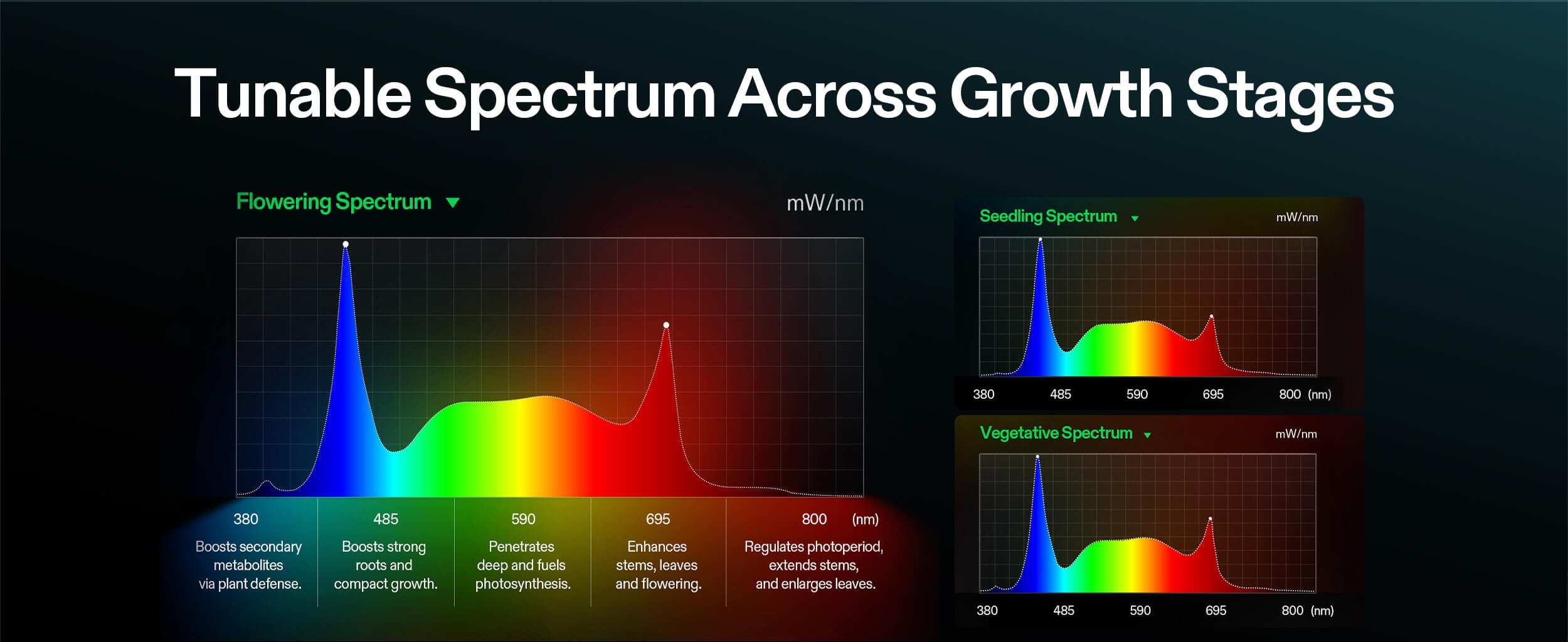
Full-Spectrum vs Tunable-Spectrum Grow Lights
Once you understand how spectrum needs change across a grow cycle, the next decision is whether to use a fixed full-spectrum light or a tunable-spectrum system that adjusts automatically.
| Full-Spectrum Grow Lights | Tunable-Spectrum Grow Lights | |
|---|---|---|
| Spectrum output | Fixed ratio of blue, red, far-red across the whole grow | Adjustable ratio, shifts by growth stage |
| Best for | Simplicity, single-light setups, growers who want "set and forget" | Growers who want stage-specific optimization |
| Control method | None — spectrum is built into the fixture | App or controller-based (e.g., seedling/veg/flower modes) |
| Flexibility | Low — same spectrum for seedling through flower | High — spectrum shifts as the plant matures |
| Learning curve | Very low | Low to moderate, especially with app-guided controls |
Buying advice: If you're running a single tent with one strain and want minimal setup, a well-balanced full-spectrum LED is a solid, low-maintenance choice. If you want to optimize each stage of growth, reduce stretch during veg, and maximize bud development during flower without swapping fixtures, a tunable-spectrum system gives you meaningfully more control — especially when it's paired with app-based automation instead of manual dial adjustments.
How to Adjust Grow Light Spectrum for Different Growth Stages
Manually changing spectrum used to mean swapping bulbs or fixtures between growth stages. Smart grow systems have simplified this into a few taps or button presses.
Adjusting Spectrum With VIVOSUN GrowHub
The VIVOSUN GrowHub Controller is built specifically to manage spectrum, intensity, and environment together, so growers don't have to treat lighting and climate control as separate systems.
GrowHub Controller
The GrowHub connects directly to compatible VIVOSUN grow lights and lets you switch between Seedling, Vegetative, and Flower spectrum modes right from the controller. On models like the GrowHub E42A+, long-pressing the spectrum button cycles through the available modes, and the built-in display shows exactly which spectrum and intensity setting is currently active — no guesswork required.
VIVOSUN App
For growers who prefer remote control, the VIVOSUN App connects to the GrowHub over WiFi and mirrors the same manual controls: day/night cycles, light spectrum, intensity, and fan speed can all be adjusted from your phone. The app also includes preprogrammed Grow Recipes designed around the seedling-to-flower cycle, so spectrum, photoperiod, and ventilation automatically shift as your plant matures — plus a Grow Diary that logs spectrum and intensity history over time.
Seedling / Veg / Flower
Both the GrowHub display and the VIVOSUN App organize spectrum control around the three core growth stages. Selecting a stage automatically applies the corresponding spectrum ratio to compatible lights, removing the need to manually calculate blue-to-red ratios yourself.
Spectrum Adjustment
This stage-based control is what makes tunable spectrum practical for everyday growers. Instead of researching ideal nanometer ratios, you select "Seedling," "Veg," or "Flower," and the connected light adjusts its output accordingly — whether you're standing at the controller or making the change remotely through the app.
Frequently Asked Questions
What is the best light spectrum for plants?
There is no single spectrum that is best for every plant or growth stage. In general, a balanced spectrum containing blue and red wavelengths can support the full grow cycle, while tunable-spectrum lights allow growers to adjust the spectral balance as plants mature.
What color light is best for seedlings?
Blue-dominant light at lower intensity is best for seedlings. It supports compact, sturdy growth and healthy leaf development without pushing young plants to stretch before their root systems are established.
Is red or blue light better for plants?
Neither is universally "better" — they serve different purposes. Blue light supports vegetative structure and compact growth, while red light drives photosynthesis and flowering. Most growth stages benefit from a mix of both, with the ratio shifting depending on whether the plant is in a vegetative or flowering stage.
Is far-red light good for plants?
Yes, in the right amount. Far-red light boosts photosynthetic efficiency when combined with red light (the Emerson Effect) and can help trigger the transition into flowering. Too much far-red without enough red, however, can cause excessive stretching.
Is UV light necessary for plant growth?
UV light isn't required for basic photosynthesis, but controlled exposure can strengthen plants against stress, pests, and pathogens, and may support pigment and trichome production during flowering. Because high UV doses can damage plant tissue, it should be introduced gradually and in limited amounts.
What is the best spectrum for flowering?
A red-heavy spectrum supported by far-red light is generally best for flowering, since red light drives the photosynthesis needed for bud development while far-red improves efficiency and supports flower finish. Small amounts of UV can also be added during this stage.
What is the difference between full-spectrum and tunable-spectrum grow lights?
Full-spectrum grow lights emit a fixed blend of wavelengths designed to work across all growth stages. Tunable-spectrum grow lights let you actively adjust the blue-to-red-to-far-red ratio as your plant moves from seedling to vegetative to flowering, typically through an app or controller.
Grow Smarter With VIVOSUN AeroLight
Getting spectrum right at every stage doesn't have to mean manually swapping lights or calculating nanometer ratios. The VIVOSUN AeroLight is built with spectrum tuning across Seedling, Vegetative, and Flowering modes, and pairs directly with the VIVOSUN GrowHub Controller and VIVOSUN App for on-the-fly adjustments — plus built-in airflow to keep your canopy cool as intensity increases through flower.
Whether you're dialing in your first grow tent or upgrading to a fully connected smart grow system, VIVOSUN's tunable-spectrum lineup takes the guesswork out of matching light to growth stage. Explore VIVOSUN AeroLight and Smart Grow Systems